A group of 22 middle school and high school students, along with 5
staff and parents, from the Pacific Community Charter School traveled
to Southern California in early April to participate in the Catalina Environmental Leadership Program (CELP). The group stopped for a night in Manhattan Beach before heading
to the San Pedro Port where they took an hour and half ferry ride to Howland’s
Landing on Catalina Island.

A group of nearly ninety 7th and 8th
graders from a French immersion school, Le Lycée Français de Los
Angeles, were also on the ferry headed over to spend the week at CELP. Middle
school students Steven Mitchell and Lewis Mueller stood before the group of 90
Le Lycée students during one group mealtime to share about their school,
describing it “as really small with 68 K-12 students and a focus on outdoor
learning.”

The Catalina Environmental Leadership Program is a residential outdoor
environmental education program located on the west end of Santa Catalina
Island. While at CELP, students participate in a series of land and sea
explorations with a focus on marine science. According to the CELP program
description, “Catalina’s unique ecosystems create living classrooms which are
ideal for hands-on, experiential learning.”

Students spent
the week studying the marine and island ecosystems. They learned about the kelp
forest and sandy bottom ecosystems first-hand while snorkeling and kayaking. A
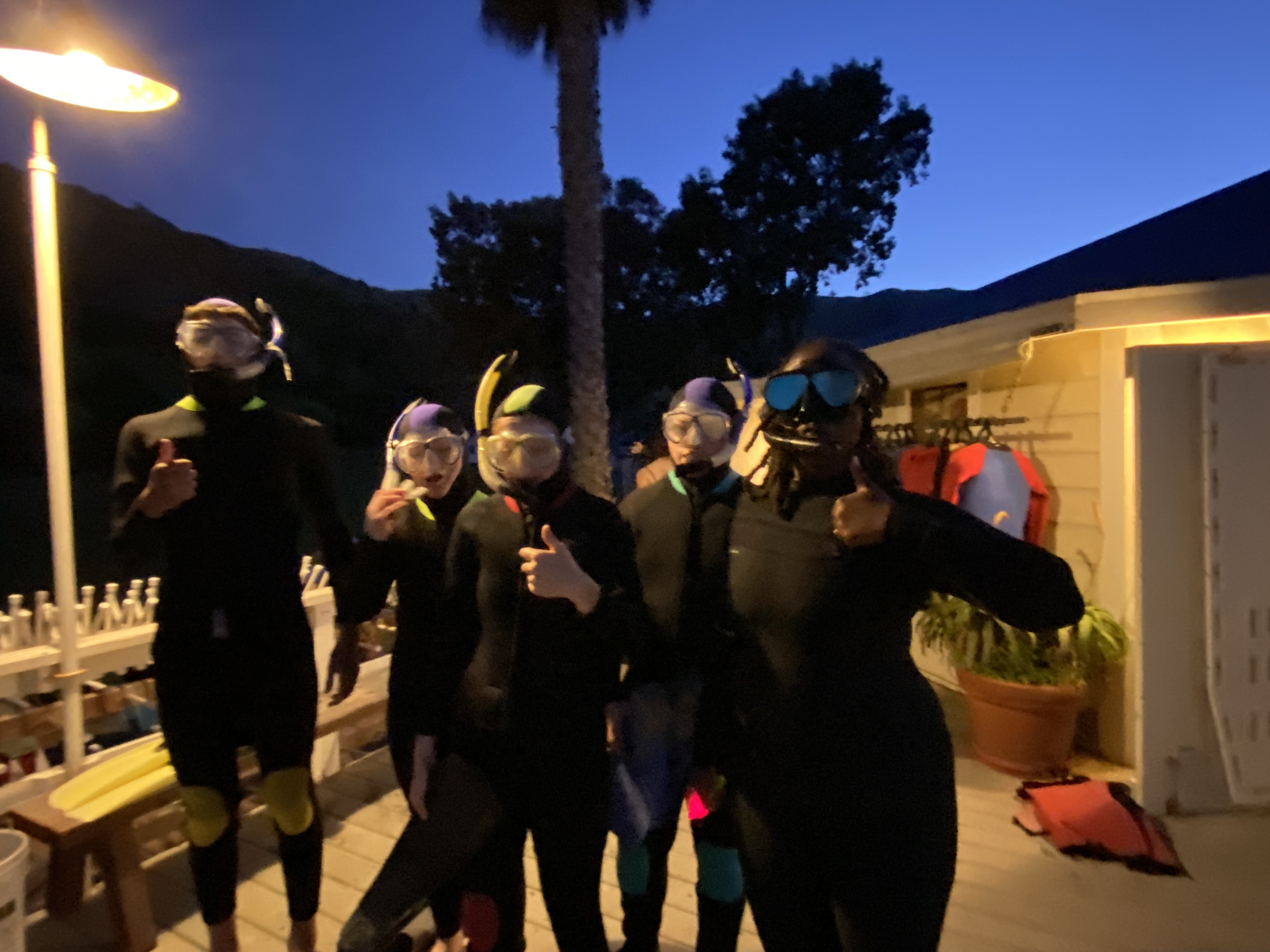
night snorkel encouraged students to find night-dwelling sea creatures,
including bioluminescent dinoflagellate that was visible when all the
underwater flashlights were turned off and the students churned the water to
illuminate the sparkling plankton. Freshman Kady Swartz “really liked the
bioluminescence and night snorkel. It was fun.”
A shoreline investigation included time in the
marine lab to view organisms under the microscopes. Day hikes discovering the native
and endemic flora were complemented with evening hikes learning about the
constellations.

The science-focused curriculum
was supplemented with initiatives designed to emphasize cooperation, leadership
and personal responsibility while cultivating connections that build a
successful team. This was an especially important benefit
of the program when considering the social and emotional impacts the pandemic
has had on young people.

Before catching the shore boat to the ferry in Two Harbors,
CELP educators encouraged students to return to the island. The fact that camp
counselors only needed to be 18 to teach at their summer camps piqued the
interest of at least one student. On the way home, the group stopped for the
night in San Luis Obispo and took a morning tour of Cal Poly, planting more
seeds of future opportunities for these students.

This is the 4th CELP field study that the Pacific School has organized over the past decade. The previous three CELP trips were aimed at 7th and 8th grade students, but this year it was offered to high school students too since they missed out on other field study opportunities over the course of the pandemic.
Students helped fund the CELP field study by developing
fundraising plans and participating in local events such as Hometown Holidays
and the Native Craft Fair; families also provided individual contributions.
Supplemental funding provided by the Redwood Coast Education Foundation,
Community Foundation of Mendocino County, ACORN Partners in Educataion and Soroptimist of Mendocino-Sonoma Coast allowed access for all students.
 pacificcharterschool.org